Press
Everything here is text on the page, ready to copy. There is no kit to download.
How to Market to a Machine: What to Do When the Buyer Sends an AI Agent, by Bob Calabritto. IdentiBlock Press. Last updated 2026-10-02.
The one sentence
A field manual for marketers whose first reader is now an AI agent: what it extracts, what it discards, and what to change on your site this quarter.
Bio, 29 words
Bob Calabritto watches software read marketing for a living. He is VP of Marketing at the Decentralized Cooperation Foundation and the author of How to Market to a Machine.
Bio, 57 words
Bob Calabritto watches software read marketing for a living. He is VP of Marketing at the Decentralized Cooperation Foundation, which works on AI safety and blockchain for the public good. He came to it by way of sports medicine, hospital marketing, Pfizer, and eighteen years in Bali. How to Market to a Machine is his first book.
Bio, 160 words
Bob Calabritto watches software read marketing for a living. He is VP of Marketing at the Decentralized Cooperation Foundation, which works on AI safety and blockchain for the public good, and where he both watches and builds the way agents are rewriting his profession. He got there by an unlikely road, one that started with taping ankles for his beloved LSU Tigers and ran through hospital marketing, a physicians' network, and a return to sports medicine for pharmaceutical giant Pfizer. Then, disgruntled with corporate life, he left for a three-month soul-searching trip to Bali that turned into eighteen years, a garment agency, a magazine, a few restaurants, a screenwriting manager, and a consultancy that changed its name more than once. He has written for Time, the New York Times and the Sydney Morning Herald. How to Market to a Machine is his first book, and it argues that the most important reader you have can be informed but never sold.
Selected questions and answers
-
You spent twenty years learning to market to people. What was the moment you realised the reader had changed?
Inside a dashboard, by accident, which I suspect is how most marketers will find out. For months I had a slice of traffic filed under "direct" in analytics that converted better than anything around it, and it was direct only because nobody had told the dashboard that AI assistants were a kind of referrer. Once I saw where those visits were coming from, the rest of the chart started looking different. Nothing announced it. There was no memo. What moved me was conversion data from my own funnels, not a vendor's slide, and the fact that I'd spent longer than I should have filing the whole thing under "interesting, but not yet."
-
The book says a machine reader can be informed but never sold. What does that actually take away from a marketer's job?
The part most of us were proudest of. Every technique I ever billed for, the headline test, the engineered moment of urgency, the hero section that took a week, rests on the assumption that the reader is a person who buys the story first and justifies it with the spec sheet afterward. An agent starts at the spec sheet and never gets to the story. It skips everything designed to make someone feel something and extracts everything that lets a reader verify something. That leaves the marketer with evidence, structure and consistency across every page the company has ever published. It is less glamorous work. It is also the first time in my career that the honest company has a structural advantage over the well-funded one.
-
You argue the traffic companies lost to AI summaries was close to worthless. That's not what most marketing teams believe. Why are they wrong?
They're grieving a chart, not revenue. Split any organic traffic report by intent and the layer AI summaries eat is the educational long tail, the "what is resource management" sessions, which in the book's model funnel is seventy percent of organic and converts at two tenths of a percent. The comparison and branded layers, the ones that produce nearly all the demos, are the ones an agent still has to visit, because it needs the price and the spec table to finish its job. Chapter 3 runs the arithmetic on one imaginary company in about ten minutes. Redo it with your own numbers. Yours will be uglier than the model's and more useful, and they'll show that the loss hurts reported metrics far more than it hurts the business.
-
You run part of your own marketing through AI agents. What do they do with competitors' pages that you didn't expect?
Two things. The first is how little of the page survives. The brand video does nothing, the testimonial wall does nothing, the adjectives evaporate, and what comes out the other side is the published price, the spec table and any claim with a number attached to it. The second is that the agent reads the whole company, not the page. It will find the pricing page, a two-year-old blog post and a partner listing that quote three different figures, and it treats the disagreement as a reason to trust none of them. Watching your own profession get speed-read by software is clarifying, and mildly humiliating.
-
Chapter 14 is a list of things you expect to be wrong about within a year. Why write it?
A book about something moving this fast should date itself before a reviewer does it for you. So the last chapter carries a timestamp, ranks the book's own claims by how likely each one is to fail, and puts two things next to every prediction: what it costs the reader if I'm wrong, and which chapter to reread if that happens. Each one has a specific test attached, the day a sponsored line changes an unsponsored answer, the day a sentence on a platform's page gets quietly edited, so anyone can grade it without taking my word for the score. The book spends thirteen chapters telling marketers that unverifiable claims are worthless to a machine reader. Ending it with unverifiable confidence would have been the one joke in the book I hadn't intended.
Pull quotes
A machine reader can be informed. It cannot be sold.
Twenty years of learning to write a hero section, and the most influential reader of the decade wants the pricing table in valid markup.
Marketing to a machine turns out to look a lot like the honest version of the job.
The cover
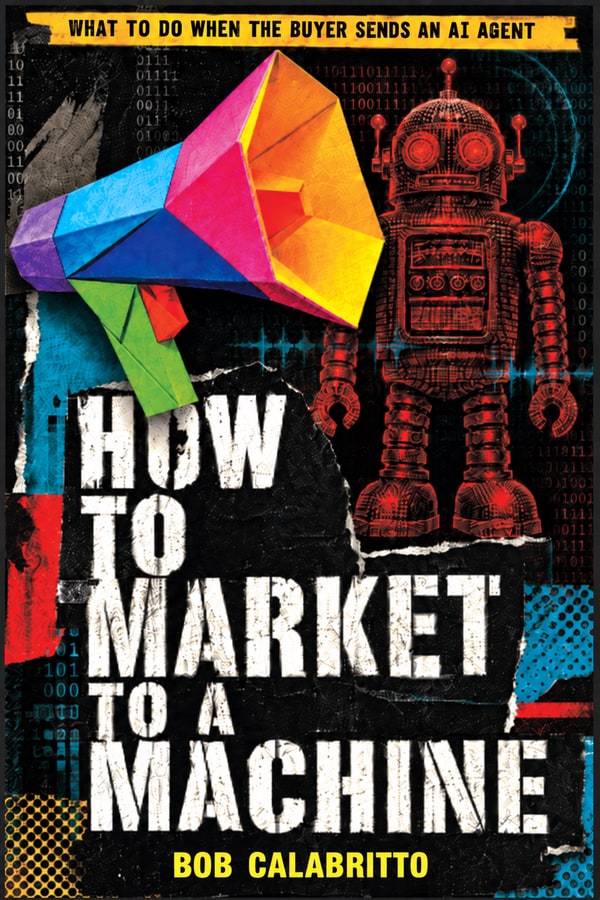
- 600 by 900 pixels Web use, a blog post or a listing. JPEG, 158 KB.
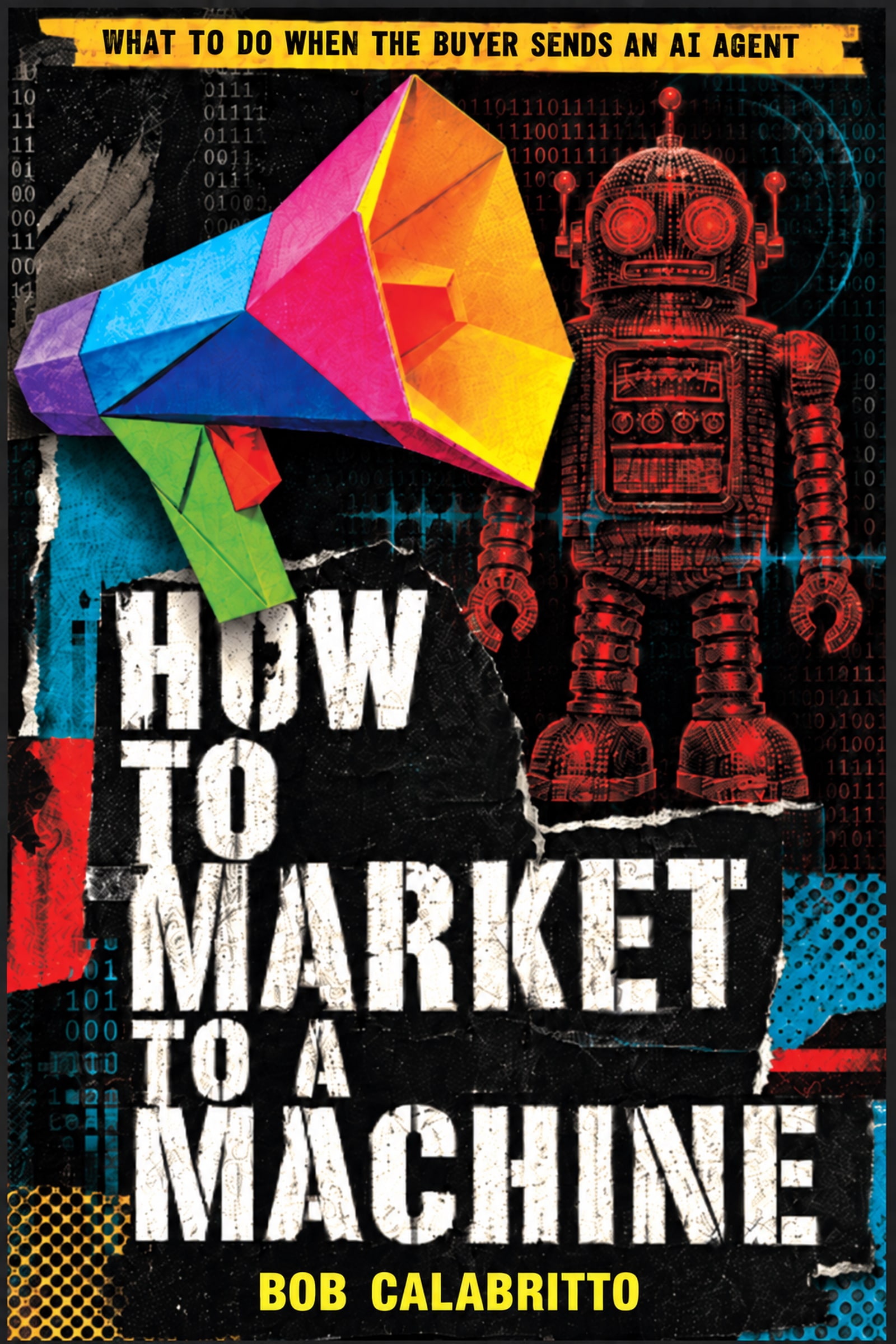
- 1600 by 2400 pixels A slide, a programme, or a press page. JPEG, 633 KB.
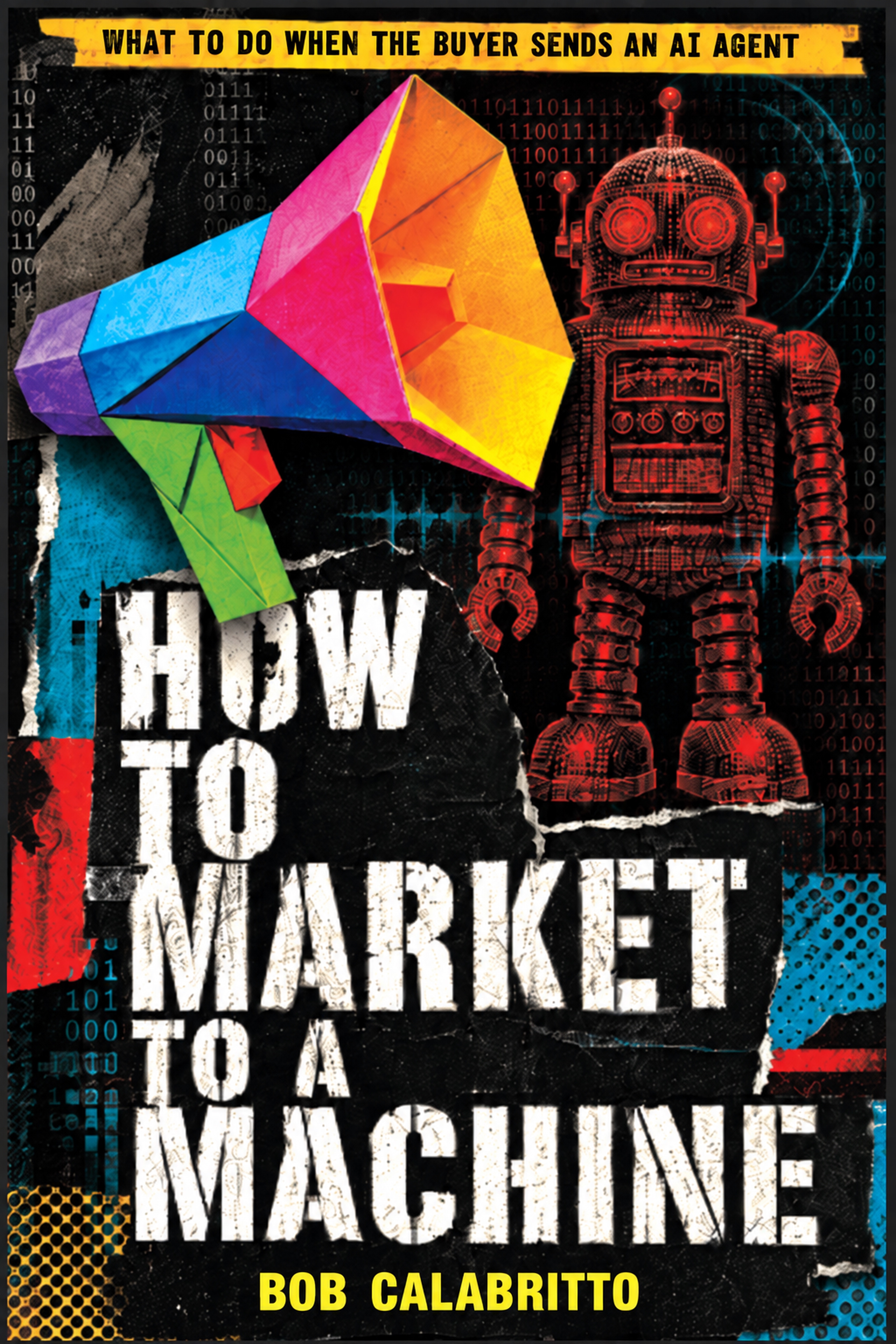
- 4096 by 6144 pixels The full master, for print at 300 ppi. JPEG, 2.6 MB.
Publication facts
- Title
- How to Market to a Machine
- Subtitle
- What to Do When the Buyer Sends an AI Agent
- Author
- Bob Calabritto
- Publisher
- IdentiBlock Press
- Published
- 2026-11-10
- ISBN, paperback
- 979-8-9979891-0-1
- ISBN, hardcover
- 979-8-9979891-1-8
- ISBN, ebook
- 979-8-9979891-2-5
- Price, paperback
- USD 19.99
- Price, hardcover
- USD 34.99
- Price, ebook
- USD 9.99
- Buy, ebook
- Kindle ebook on Amazon
- Last updated
- 2026-10-02